A product doesn't become successful because someone had a good idea. It becomes successful because a loop was run enough times, deliberately: understand why people behave the way they do, design something around that behavior, test whether the design actually holds up, and read the data honestly enough to know what to do next. Intuition starts the loop. Systems thinking, psychology, and product analysis are what keep it turning.
This is the process I use — not as a one-off framework, but as the operating system behind every feature, redesign, and retention push I've shipped. It's the same process I'd bring into a product team on day one.
Every product is a growth loop, and every loop runs on a human need
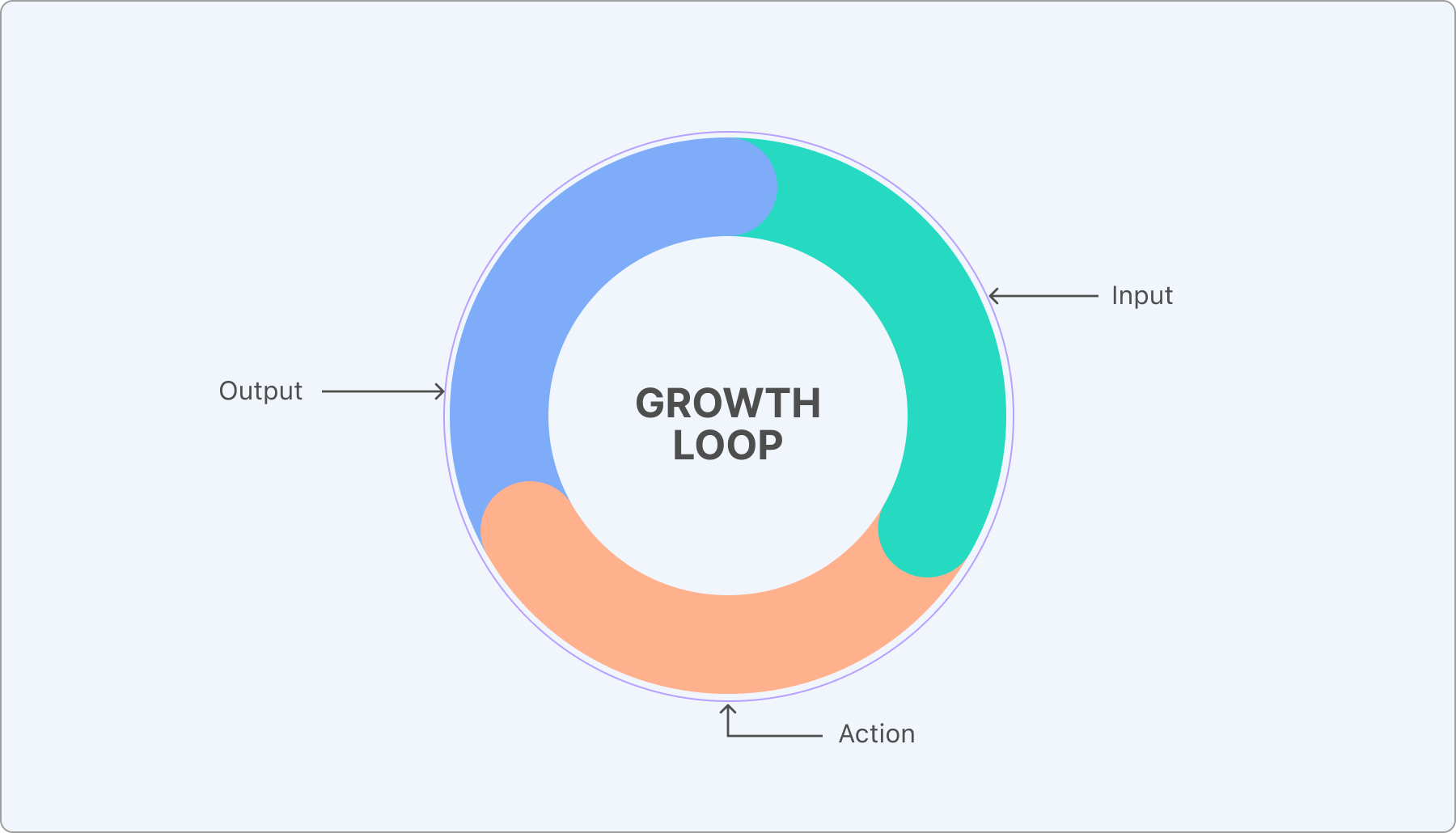
Strip any digital product down to its mechanics and you find the same four-part structure: an input enters the system, an action transforms it, an output is produced, and — if the loop is healthy — that output becomes the input for the next cycle. This is activation, and it's the difference between a product people try once and a product people return to.
But a growth loop is never purely mechanical. It works because it serves something constant in human behavior — belonging, status, trust, control, identity. These needs don't change across eras or categories. What changes is how well a product's mechanics tap into them. When an interaction feels natural enough to become a habit, humanity becomes habit. When a user can shape something and make it theirs, agency becomes ownership. Those two conversions — humanity into habit, agency into ownership — are the fuel behind every loop that actually compounds.
Knowing the psychology is half the job
Understanding how people think improves retention by reducing friction before it happens. Reducing cognitive load means fewer choices at the moment they matter (Hick's Law), fewer steps between a user and their goal, and a fast first win that proves the product's worth immediately. Harnessing cognitive bias means framing renewals around what's lost rather than what's gained (loss aversion), giving users a role in setup so the product becomes theirs (the IKEA effect), and reassuring people they made the right call through milestones and progress summaries (confirmation bias). Building habit loops means surfacing unfinished tasks to create a pull to return (the Zeigarnik effect) and anchoring reminders to real user actions instead of arbitrary send times.
None of this is decoration. It's the difference between a product that people abandon at the first point of friction and one that quietly becomes part of someone's routine — familiar (Jacob's Law), scannable within five seconds, and clear about what to do next.
Psychology explains why a design choice should work. Only testing tells you if it actually did — for this product, with these users, in this context.
Turning a hypothesis into a decision
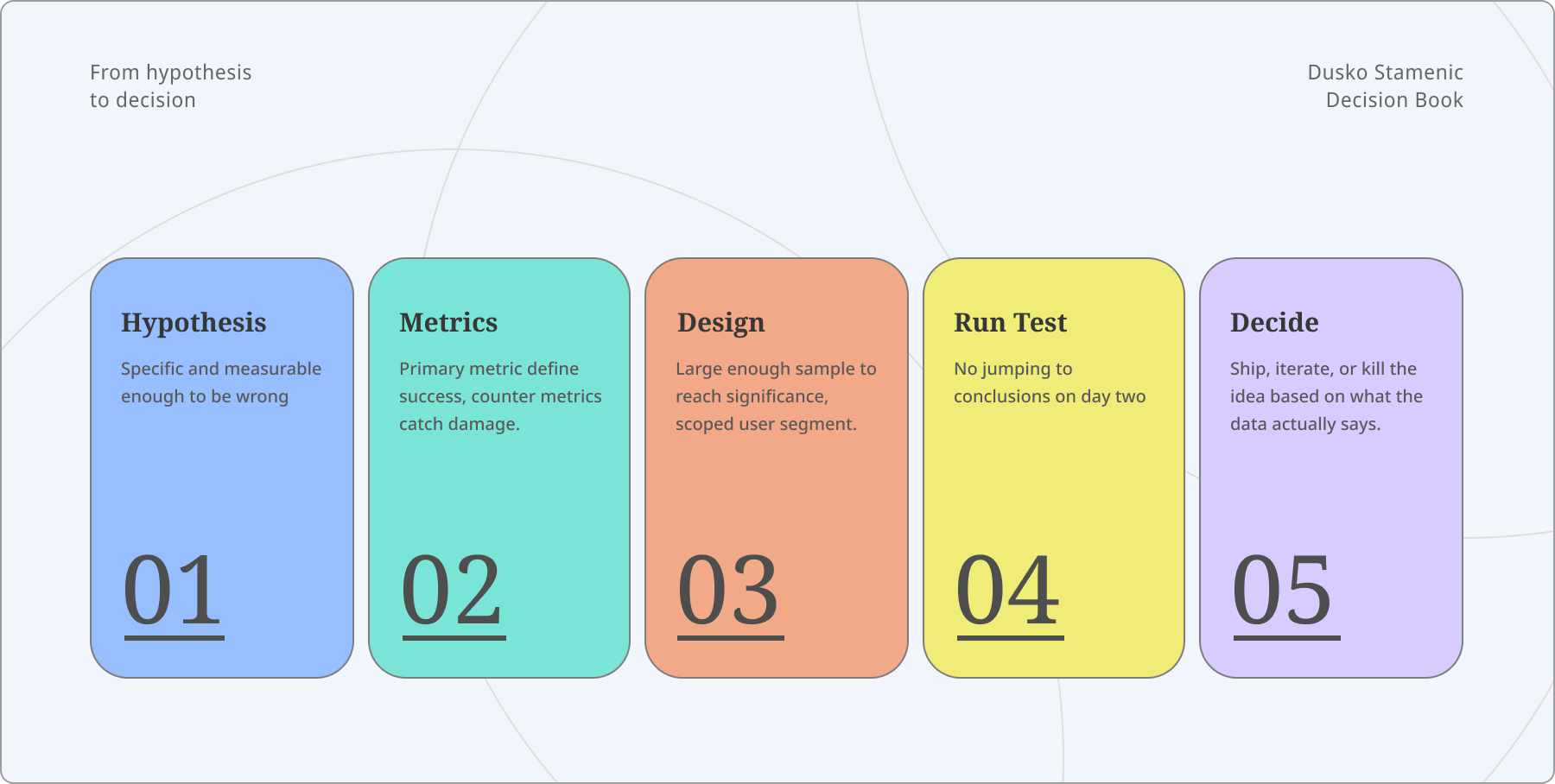
Applying a psychological principle to a design is a guess until it's tested. My process for closing that gap has five steps: define a hypothesis specific and measurable enough to be wrong ("adding X will increase Y"); set success metrics, both the primary metric that defines success and the counter metrics that catch unintended damage; design the experiment with a real control, a large enough sample to reach significance, and a clearly scoped user segment; run it without jumping to conclusions on day two; and analyze and decide — ship, iterate, or kill the idea based on what the data actually says, not what the hypothesis hoped for.
Retention tells the truth activation can't
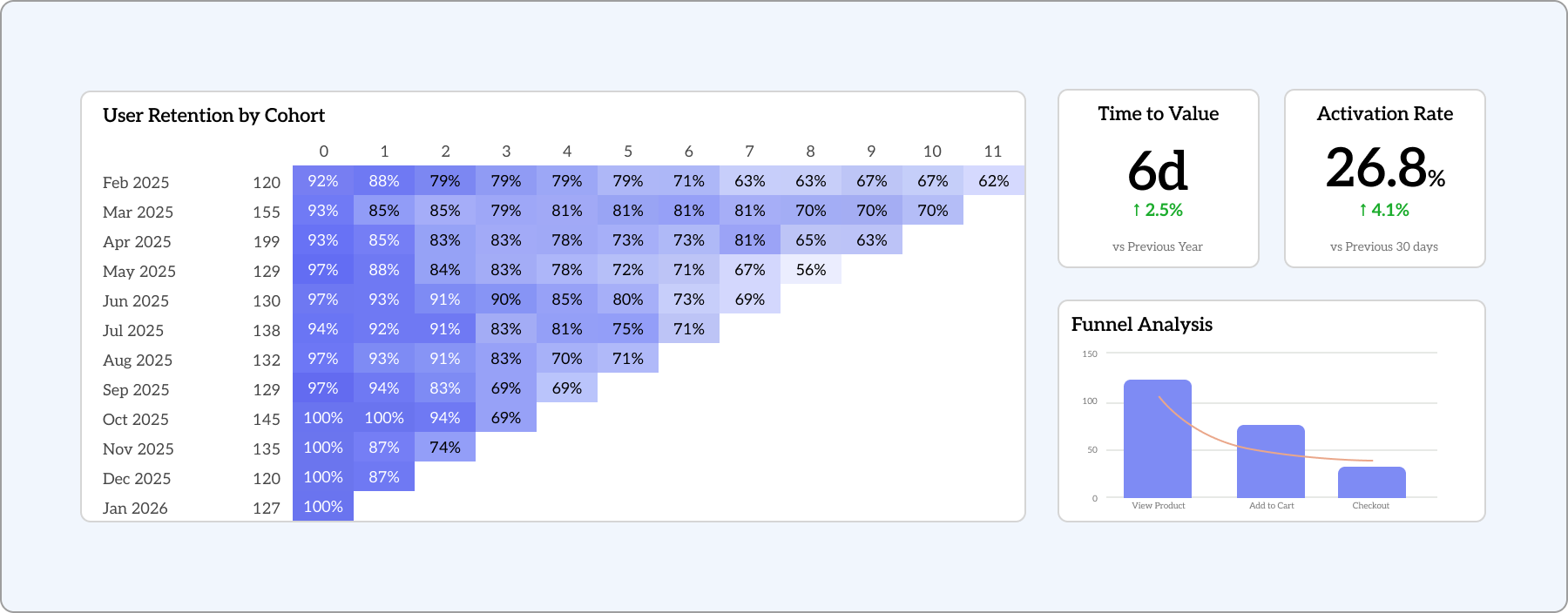
People say one thing, and do another. Behavioral data is where the gap between the two shows up — and it's often more honest than what research alone can surface. One method I rely on: take the users who've stuck around for three to six months, look at which checkpoints they actually passed through, and use that pattern — not a generic "aha moment" — to optimize the route for everyone else. Most journey maps assume one universal aha moment; most products don't have one. The real question is narrower: has this user reached the point where they know the tool can do the job they hired it for?
This is also where Time-to-Value earns its place — not first click, not first session, but the first moment of felt usefulness. For a note-taking app, that's a note revisited days later. For an analytics product, it's the first insight that changes a decision. And it's where user-initiated expansion — teammates invited, workspaces created, new use cases found — signals something upsells can't force: the product has stopped being a tool and started being infrastructure.
The payoff of taking data seriously is that it also tells you what to cut. In one redesign, the question wasn't "how do we improve this integration" — it was whether the integration should exist at all. Usage data showed it hadn't been used in the way that mattered for over a year. It was removed, not redesigned.
The same funnel means different things in different businesses
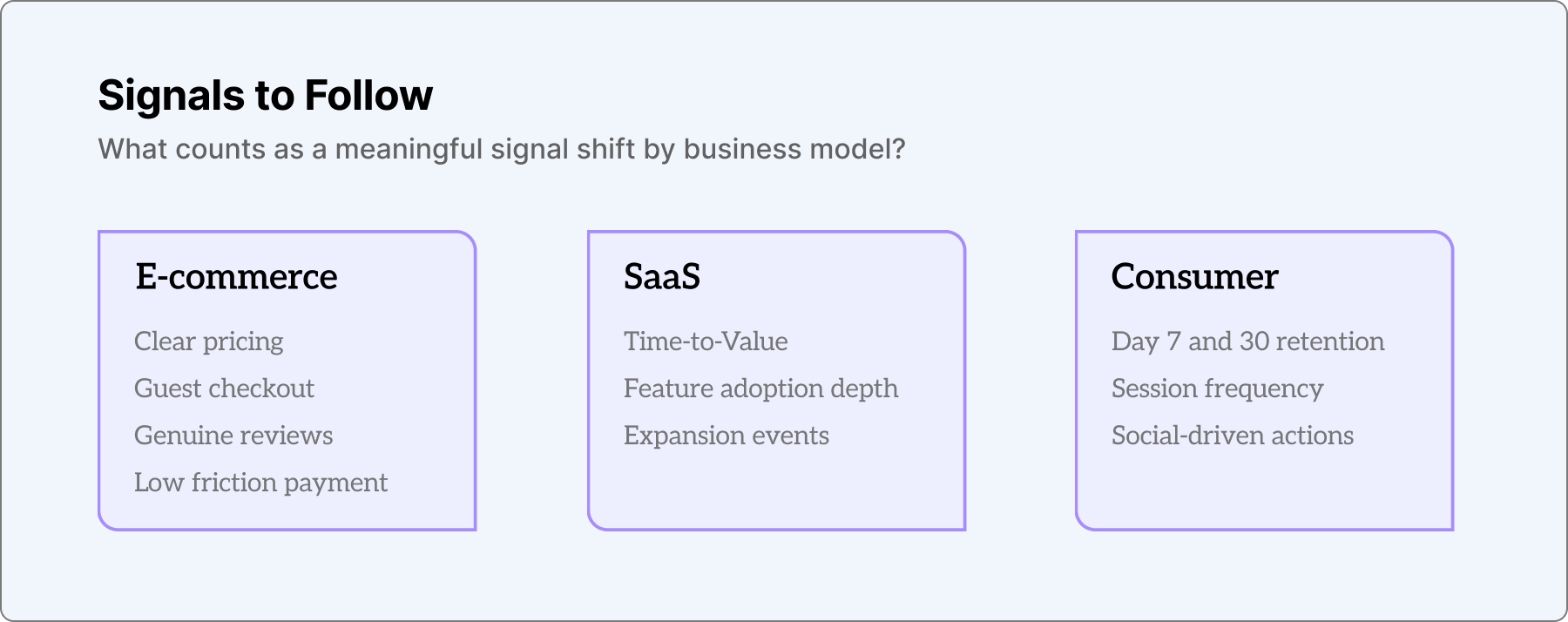
Activation and retention are the metrics a product team can move without waiting on marketing or sales — but what counts as a meaningful signal shifts by business model. In e-commerce, the loop is short and trust-driven: clear pricing, guest checkout, genuine reviews, and low friction at the point of payment matter more than deep engagement, because the product only needs to earn one high-intent decision at a time. In SaaS, the loop is longer and value has to be demonstrated repeatedly — Time-to-Value, feature adoption depth, and expansion events (seats, workspaces, integrations) matter more than any single session, because the business depends on people coming back on their own. In consumer products, the loop is about habit and identity — day 7 and day 30 retention, session frequency, and social or status-driven actions matter most, because the product is competing for attention, not just utility.
The mistake is applying one playbook everywhere. A SaaS-style focus on expansion metrics undersells a consumer product's need for daily habit formation. An e-commerce-style focus on single-session conversion undersells a SaaS product's need to prove value over weeks, not seconds.
What's engraved in product success
Strip away the tools and the frameworks, and product success comes down to a small number of engraved truths. Human needs don't change — belonging, status, trust, control, identity are the constants every mechanic has to serve. Business needs set the frame — the same behavioral signal means something different depending on whether the business runs on single transactions, recurring value, or daily attention. Experimentation replaces opinion with evidence — a disciplined five-step process turns "I think this will work" into "we know this works, for these users, and here's the data." Metrics without context mislead — an activation event can look healthy and still hide a self-selected segment that was always going to stick around regardless. And the loop never really closes — every round of testing and analysis feeds straight back into the next design decision.
This is the process I look for in a role before I look at the job title: a team that treats psychology, systems thinking, and data as one continuous discipline — not three departments handing off a spec.